


What a Major Earthquake Reminds Us About Building Design: An Architect's Reflection on the Role of Structural Engineers

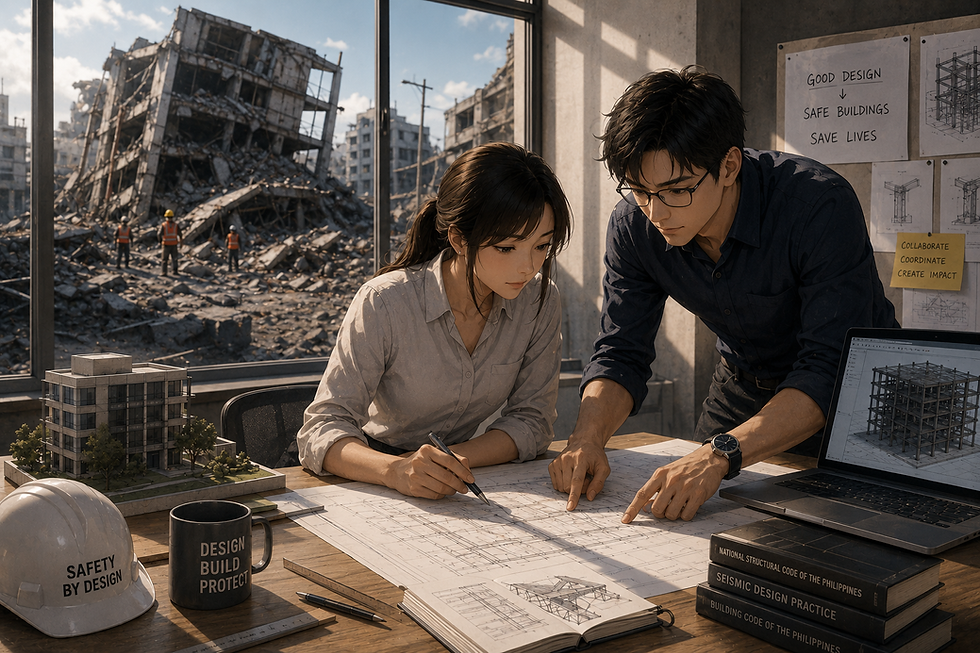
When news breaks of a major earthquake, most people understandably focus on the immediate impacts: damaged buildings, disrupted lives, injured occupants, and communities struggling to recover.
For architects, engineers, contractors, and building owners, however, such events also raise an important question:
Why do some buildings survive while others fail?
The recent strong earthquake that affected parts of Mindanao serves as a sobering reminder that architecture is not only about aesthetics, functionality, and space planning. Every building is ultimately a physical structure that must withstand the forces of nature.
And behind every safe building stands a profession that often receives less public attention than it deserves:
Structural engineering.
As architects, we are responsible for envisioning spaces where people live, work, worship, learn, and gather. Yet no architectural vision can fulfill its purpose if the structure itself cannot protect the people inside it.
This is why structural engineers are not simply consultants added to a project team. They are essential partners in transforming architectural ideas into buildings that are safe, resilient, and capable of standing the test of time.
Earthquakes Do Not Judge Buildings by Appearance
When a major earthquake strikes, it does not care whether a building is beautiful, expensive, modern, or iconic.
The forces generated by seismic events act on every structure according to the laws of physics.
A building's survival depends on factors such as:
Structural system selection
Quality of engineering design
Construction workmanship
Soil conditions
Material quality
Compliance with building codes
Maintenance throughout its lifespan
Many buildings that appear strong may contain hidden weaknesses. Conversely, some modest-looking structures may perform remarkably well because they were properly engineered and constructed.
This reality highlights an important distinction that is often overlooked by the public:
Architecture determines how a building is experienced. Structural engineering determines whether that building can safely resist the forces acting upon it.
Both are essential.
The Misconception That Buildings Are Designed to Be Damage-Free
One of the most common misconceptions about earthquake-resistant design is the belief that buildings should emerge from major earthquakes completely undamaged.
In reality, modern seismic design follows a different philosophy.
Buildings are generally designed with a primary objective:
Protect Human Life
This means that during a severe earthquake:
Structural elements may crack.
Finishes may be damaged.
Ceilings may collapse.
Glass may break.
Repairs may be necessary.
However, the structure should remain stable enough to prevent catastrophic collapse and allow occupants to evacuate safely.
This principle is reflected in the National Structural Code of the Philippines (NSCP) and in seismic design standards around the world.
A successful building is not necessarily one that remains untouched.
A successful building is one that protects lives.
Why Structural Engineers Matter From the Very Beginning
Many people assume structural engineers become involved only after the architectural design is completed.
In reality, the best projects involve structural engineers from the earliest stages of planning.
Structural decisions influence:
Building form
Floor layouts
Column placement
Span lengths
Material selection
Construction cost
Future flexibility
Long-term resilience
An architect may envision large open spaces, dramatic cantilevers, expansive glass façades, or complex roof forms.
The structural engineer transforms those ideas into systems that can safely carry gravity loads, resist wind forces, and withstand seismic events.
Good design happens when architecture and engineering work together rather than sequentially.
Every Architectural Decision Has Structural Consequences
Architects constantly make decisions that affect structural performance.
Consider a few examples:
Open Ground Floors
Many commercial and residential developments favor open parking areas on the ground floor.
Architecturally, this improves functionality.
Structurally, however, it can create a "soft-story" condition where the ground floor becomes significantly weaker than the floors above.
During earthquakes, these buildings may experience concentrated damage at the lowest level.
Large Open Spaces
Clients often request expansive living rooms, event spaces, or retail areas with minimal columns.
While achievable, larger spans require more sophisticated structural solutions and careful engineering coordination.
Building Extensions and Renovations
Property owners frequently assume they can simply add another floor to an existing structure.
Yet without structural assessment, additional loads may exceed the capacity of foundations, columns, and beams originally designed for a smaller building.
This is one reason why professional design services are not merely regulatory requirements. They are risk-management tools.
The Cost of Engineering Versus the Cost of Failure
One of the most dangerous assumptions in construction is that engineering is an area where costs can be minimized.
Professional fees are often viewed as expenses.
In reality, they are investments in risk reduction.
The cost of structural engineering is typically only a small fraction of total project cost.
The cost of structural failure can include:
Property damage
Business interruption
Legal liability
Injuries
Loss of life
Permanent reputational damage
A building owner may forget the professional fee paid years ago.
They will never forget the consequences of a building failure.
Earthquakes Reveal the Importance of Code Compliance
Major earthquakes often expose a difficult truth:
Not all buildings are created equal.
When engineers investigate damaged structures after seismic events, common issues frequently include:
Insufficient reinforcement
Poor detailing
Unauthorized modifications
Substandard materials
Lack of professional supervision
Non-compliance with approved plans
The Philippine construction industry has made significant progress in strengthening codes and standards.
However, building safety ultimately depends on consistent implementation.
A well-written code cannot protect occupants if it is ignored during design or construction.
The Architect and Structural Engineer as Partners
Architecture and structural engineering are sometimes viewed as separate disciplines.
In practice, they are deeply interconnected.
The architect considers:
Human experience
Functionality
Space
Context
Aesthetics
The structural engineer considers:
Stability
Strength
Load paths
Ductility
Resilience
The best buildings emerge when both perspectives inform the design process.
A structure that is safe but unusable is not successful.
A structure that is beautiful but unsafe is not successful either.
True building quality lies in balancing both.
What Building Owners Should Take Away
For homeowners, developers, and property investors, earthquakes provide an important reminder:
Building safety begins long before construction starts.
Before a single foundation is excavated, critical decisions have already been made regarding:
Site selection
Soil investigation
Structural system choice
Engineering design
Regulatory compliance
These decisions influence how a building performs decades later.
Choosing qualified architects and structural engineers is not simply about obtaining plans or permits.
It is about protecting lives, investments, and communities.
A Personal Reflection as an Architect
As architects, we are often associated with the visible aspects of buildings—the spaces people occupy and the forms they admire.
Yet every time we walk through a completed project, we are reminded that much of what makes a building safe is invisible.
The reinforcing steel inside a column.
The detailing within a beam-column joint.
The foundation hidden beneath the ground.
The calculations that occupants will never see.
These are the contributions of structural engineers.
Major earthquakes remind us that architecture is ultimately an act of responsibility. Every line drawn on a plan represents future occupants who trust that the building around them will protect them when nature tests its limits.
That trust cannot be achieved through architecture alone.
It is built through collaboration, professional expertise, and a shared commitment to public safety.
When the earth shakes, buildings reveal the quality of decisions made long before construction began.
And among those decisions, few are more important than ensuring that structural engineering has a seat at the table from the very start.
References
National Structural Code of the Philippines (NSCP)
Association of Structural Engineers of the Philippines (ASEP)
Philippine Institute of Volcanology and Seismology (PHIVOLCS)
Federal Emergency Management Agency (FEMA) – Earthquake Safety Resources
United States Geological Survey (USGS) – Earthquake Hazards Program



Comments